The 90-Day AI Pivot Framework for Agency Future-Proofing
Every agency owner I talk to right now is asking the same question: "What do I actually do about AI?"
Not theoretically. Not someday. Right now.
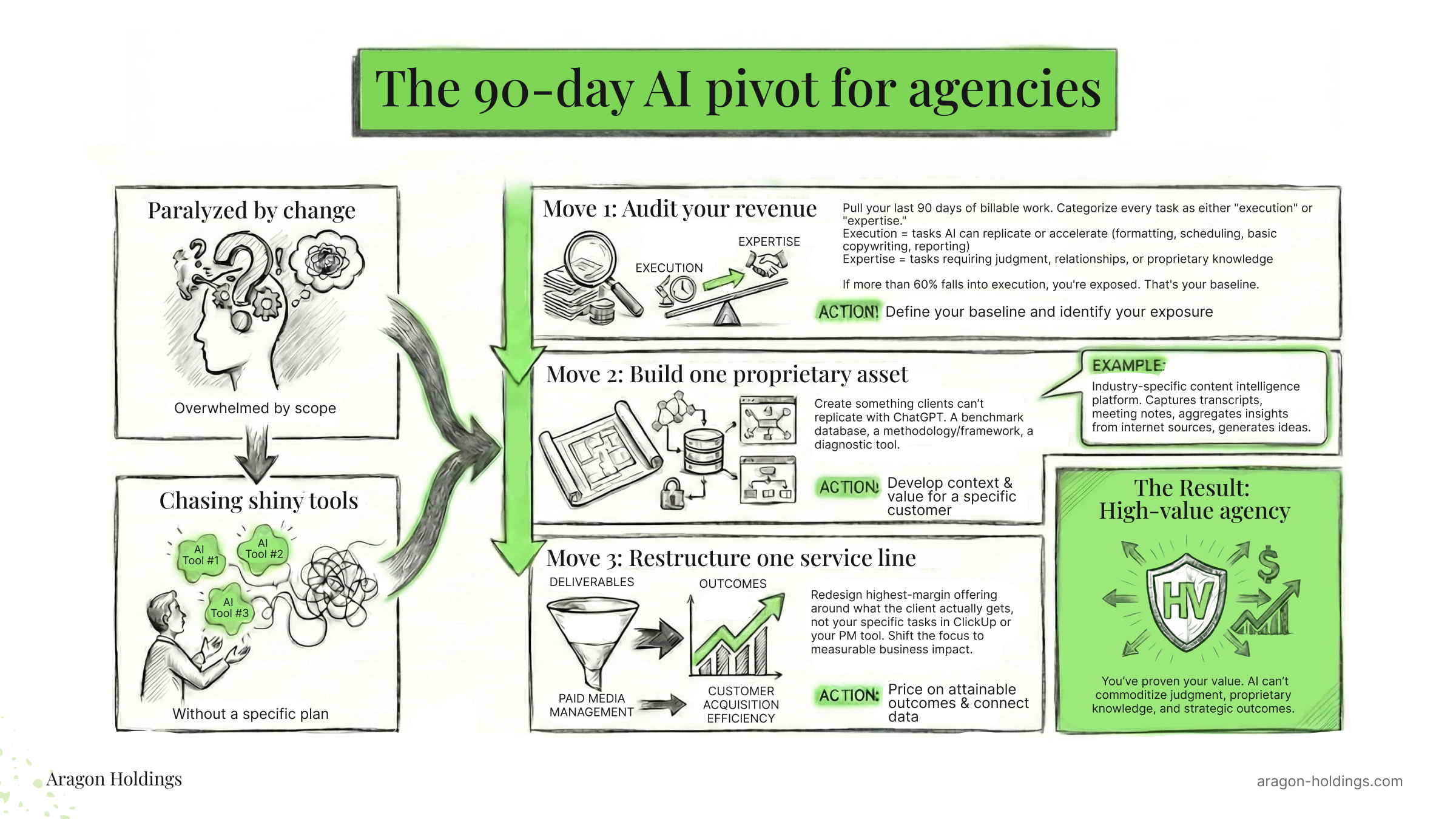
And honestly, most of them fall into one of two camps. The first group is paralyzed by the scope of change required. They see the headlines, they understand the threat, but the sheer magnitude of "transforming into an AI-enabled operation" feels impossible to tackle while also running payroll, managing clients, and keeping the lights on.
The agencies that will thrive aren't the ones with the most sophisticated AI strategy on paper. They're the ones taking concrete, measured action right now.
The second group is doing the opposite—chasing every shiny AI tool that hits the market, spinning up pilots that go nowhere, and confusing activity with progress.
Both approaches burn time you don't have.
Here's what I've learned from operating and acquiring agencies over the past several years: You can't transform overnight, but you also can't wait until you've figured it all out. The agencies that will thrive aren't the ones with the most sophisticated AI strategy on paper. They're the ones taking concrete, measured action right now.
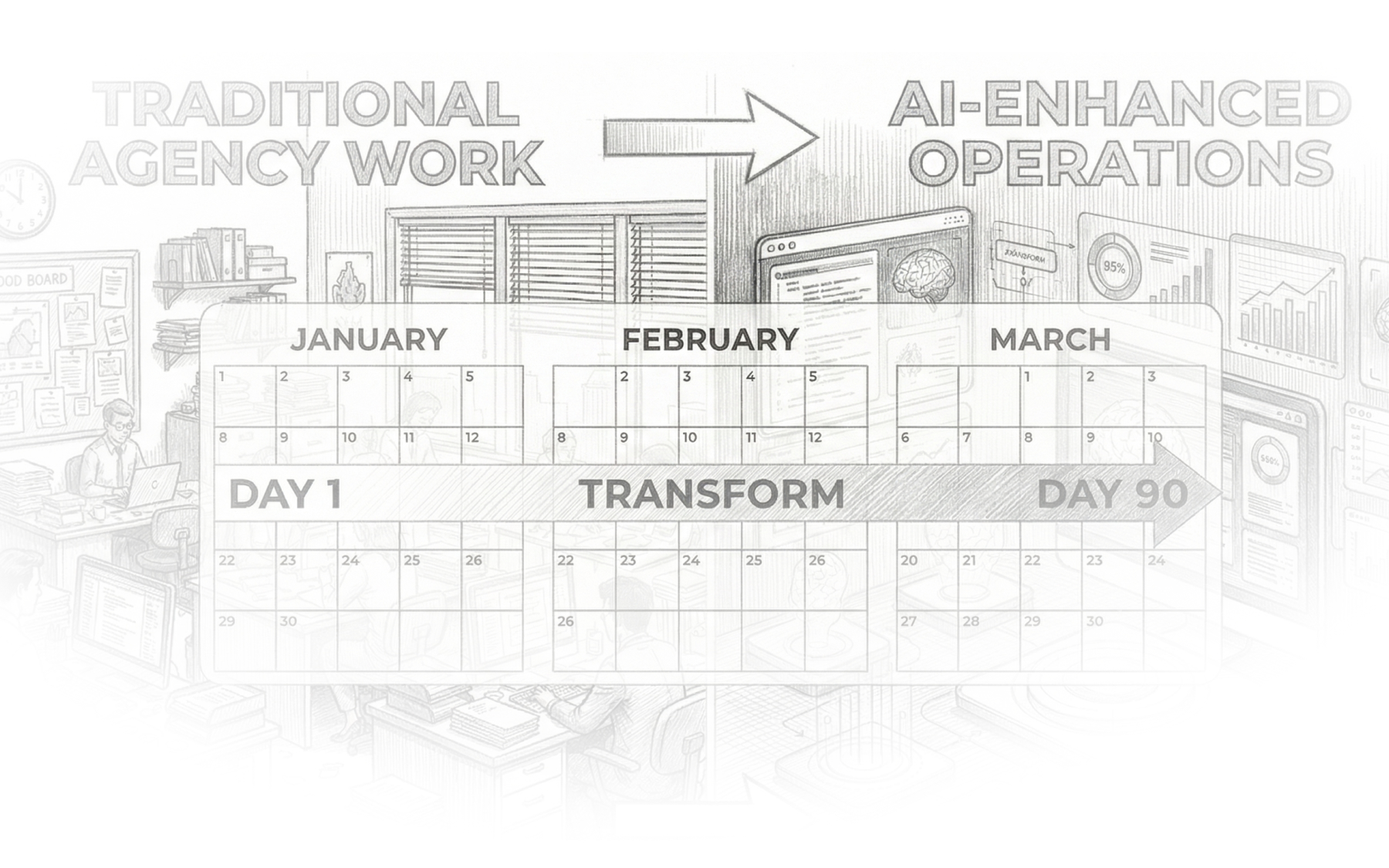
That's why I use a simple rule: Start with a 90-day pivot. Three moves. Concrete outcomes.
Let me walk you through the framework.
Move 1: Audit Your Revenue by Task Type
Before you can make any intelligent decisions about AI, you need to understand where your revenue actually comes from—at the task level, not the service level.
Pull your last 90 days of billable work. Every project, every deliverable, every line item. Then categorize each task into one of two buckets:
Execution = Tasks AI can replicate or accelerate. Think formatting documents, scheduling content, basic copywriting, pulling reports, resizing creative assets, building templated presentations, or compiling research from public sources.
Expertise = Tasks requiring judgment, relationships, or proprietary knowledge. Think strategic recommendations, client workshops, negotiating media buys based on nuanced understanding, creative direction that requires brand intimacy, or advisory conversations that shape business decisions.
If more than 60% of your billable hours fall into the execution category, you're exposed.
Here's the benchmark that should make you pay attention: If more than 60% of your billable hours fall into the execution category, you're exposed.
That doesn't mean you're doomed. It means you have a clear picture of your vulnerability—and that's the first step toward addressing it.
Most agency owners I work with are surprised by this exercise. They think they're selling expertise because that's how they talk about their work. But when they actually look at where the hours go, they find their team spending enormous amounts of time on tasks that AI tools can now handle in minutes.
This isn't a judgment. It's a baseline. You can't navigate somewhere new if you don't know where you're starting from.
Move 2: Build One Proprietary Asset
This is the move most agencies skip—and it's the one that matters most.
The uncomfortable truth is that generic deliverables are becoming commoditized fast. A client can get "content" from AI. They can get "reports" from AI. They can get "social media posts" from AI.
What they can't get from AI is something you've built that's uniquely yours—something that captures your accumulated knowledge, your industry-specific insights, or your proprietary methodology.
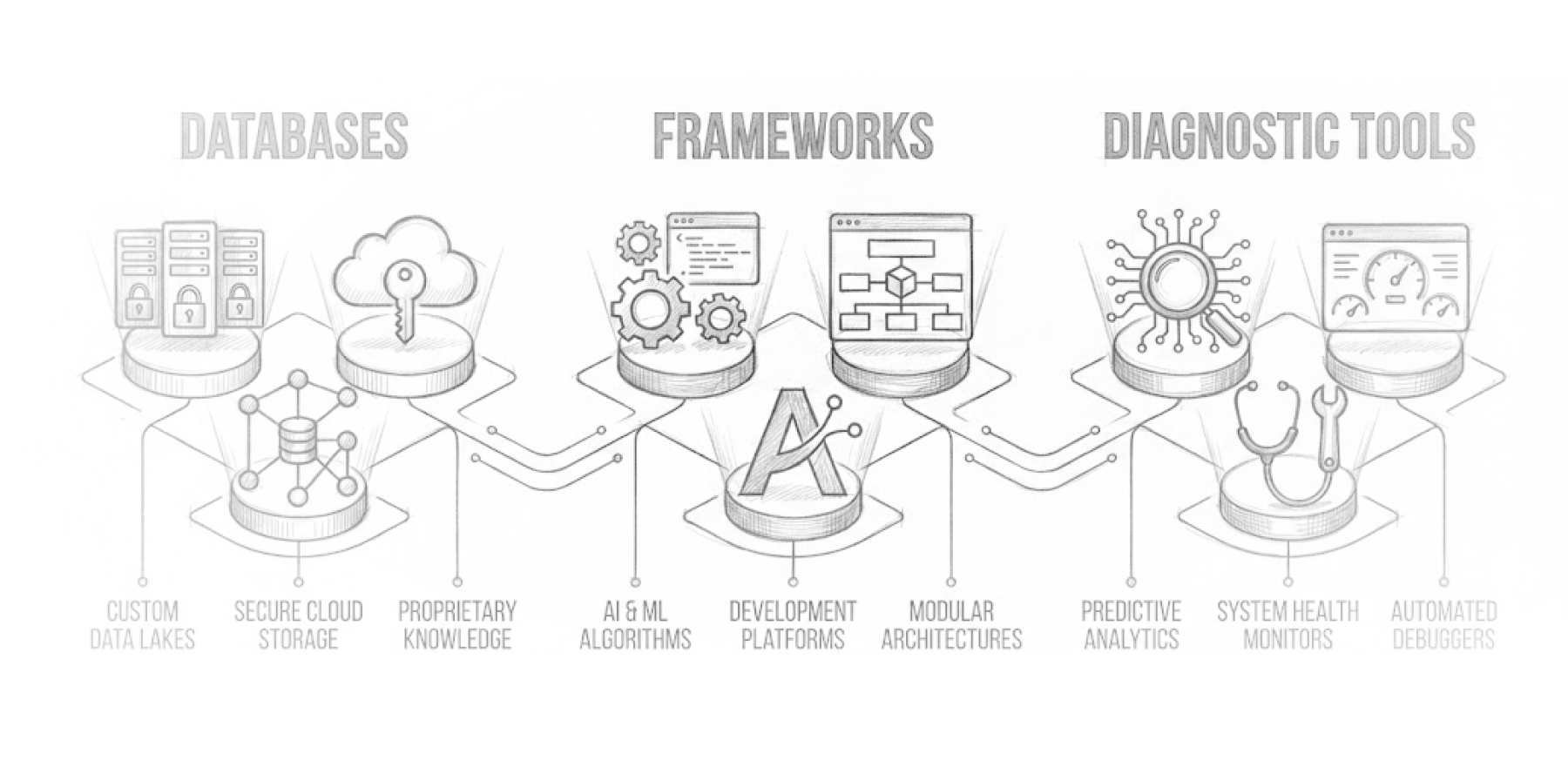
I'm talking about assets like:
- Benchmark databases that aggregate performance data across your client base (anonymized, of course) so you can tell a new client exactly how they compare to peers in their space
- Methodology frameworks that codify your approach to solving specific problems in ways that are teachable, repeatable, and defensible
- Diagnostic tools that help clients understand their situation before you even start working together
- Custom workflows that combine AI capabilities with your expertise in ways that would take months for someone else to replicate
One of our portfolio agencies built an industry-specific content intelligence system that's become central to their value proposition. It captures transcripts from client meetings, podcast interviews, and presentations. It aggregates industry insights from these conversations. It generates content ideas using custom prompts tuned to each client's voice and market. And it manages all finalized content with sophisticated categorization and tagging.
Clients aren't paying for blog posts. They're paying for access to that context engine—something that took years of accumulated knowledge to build and that ChatGPT simply cannot replicate.
The key question to ask yourself: What do we know, have access to, or do differently that would take a competitor (or an AI tool) significant time and effort to recreate?
That's your proprietary asset. Build it.
Move 3: Restructure One Service Line Around Outcomes
Here's where the rubber meets the road.
Pick your highest-margin offering—the service that drives the most profit and where you have the most confidence in your ability to deliver results. Now redesign the entire scope around what the client actually gets, not what your team does.
This is a fundamental mindset shift, and it's harder than it sounds.
Most agencies sell activities. Hours of work. Deliverables produced. Tasks completed. The problem is that AI is making those activities cheaper and faster every month. If you're competing on "we produce X pieces of content per month," you're in a race to the bottom.
But if you're competing on "we generate Y amount of pipeline influence" or "we improve customer acquisition efficiency by Z%," you're playing a completely different game.
Consider these repositioning examples:
- "Content marketing" becomes "pipeline influence"—you're not selling blog posts, you're selling measurable impact on the client's sales funnel
- "Paid media management" becomes "customer acquisition efficiency"—you're not selling campaign management hours, you're selling a lower cost per acquired customer
- "Social media management" becomes "audience development"—you're not selling posts, you're selling growth of an engaged community that converts
Outcome-based pricing typically supports higher margins because you're aligning your compensation with the value you create, not the hours you spend.
The critical piece here is making sure you can connect the dots with data. If you're going to sell outcomes, you need to be able to measure them, report on them, and prove your impact. That might require new tracking mechanisms, better analytics integration, or different conversations with clients about what data you need access to.
Price accordingly. Outcome-based pricing typically supports higher margins because you're aligning your compensation with the value you create, not the hours you spend.
Why 90 Days Is the Right Timeframe
I'm specific about the 90-day window for a reason.
Longer timelines let you procrastinate. "Digital transformation" initiatives that span a year or more have a way of never actually transforming anything. They become perpetual planning exercises.
Shorter timelines don't allow for meaningful change. You need enough runway to actually implement something, measure results, and learn from what works.
Ninety days is long enough to make real progress and short enough to maintain urgency. It's also aligned with quarterly planning cycles, which makes it easier to resource and prioritize.
At the end of 90 days, you should be able to point to concrete outcomes:
- A clear picture of your exposure to AI commoditization (the audit)
- One proprietary asset that differentiates you from both competitors and AI tools
- One service line restructured around outcomes with new pricing to match
You won't have solved everything. But you'll have proven to yourself—and to your clients—that your agency delivers value AI can't commoditize.
The Real Goal: Proof of Concept for Your Own Future
Here's what I want you to understand about this framework: The goal isn't to overhaul your entire agency in three months. That's not realistic, and attempting it would probably break things that are working fine.
The goal is to run a controlled experiment. To prove that your agency can evolve. To build muscle memory for the kind of strategic adaptation that's going to be required repeatedly over the coming years.
Because this isn't a one-time shift. AI capabilities are going to keep advancing. Client expectations are going to keep changing. The agencies that thrive won't be the ones that made one big pivot this year. They'll be the ones that built the organizational capacity to keep pivoting.
Three moves. Ninety days. That's how you start.
Key Takeaways
-
Stop waiting for the perfect strategy. The agencies winning right now are taking concrete action, not planning comprehensive transformations.
-
Audit your revenue by task type. If more than 60% of your billable work falls into "execution" tasks AI can replicate, you have a clear vulnerability to address.
-
Build proprietary assets. The only sustainable defense against commoditization is owning something clients can't get from AI—benchmark data, methodology frameworks, diagnostic tools, or custom workflows.
-
Sell outcomes, not activities. Restructure at least one service line around what clients get, not what your team does. Price accordingly.
-
Use 90 days as your forcing function. Long enough for meaningful progress, short enough to maintain urgency.
The question isn't whether AI will change your agency. It already is. The question is whether you're going to shape that change intentionally or let it happen to you.
Written by

Tristan Pelligrino
Partner at Aragon Holdings. Built and scaled multiple agencies before transitioning to acquisitions.